The Old Testament
The Old Testament is revered by Jews
The Hebrew scriptures decisively shaped the living memory and identity of a unique people. They are revered as writings from antiquity, yet treasured even today as an ever living and unceasingly relevant word. To grasp what the Hebrew Scriptures are about, think of them as revolving around some key concepts, which for simplicity we will summarize with words beginning with the letter “P.” They have to do with:
Providence—The Hebrew Scriptures manifest a constant awareness that the God who created all is involved with His creation and active in human history.
People—The people who descended from the great patriarchs—Abraham, Isaac, and Jacob—are chosen and set apart by God for unique service in, to, and for the world.
Place—The land of Israel promised to this people by God if they would faithfully follow Him.
Promise—This people and God were united by a covenant,or agreement,that God would be with them, guide them,bless them,if they would follow His ways.
Prophecy—Warnings against injustice, idolatry, and social evil, and prophecy predicting future events, including the coming of a Messiah to save and deliver.
A love letter from God
I read the Torah as Jews have read it and loved it for centuries. For example, I can tell you what is the middle word in the Torah. I can tell you what is the middle letter in the Torah.Over the generations Jewish scholars have read the Torah not as a novel to see how it ends, but as a love letter. For instance,‘Why did he use this word instead of that word?’ ‘Why is there a space here?’ ‘Why a comma here instead of a period?’ That’s the way you read a love letter and wonder,‘What did he or she mean by this word?’ We Jews have seen the Torah as not just a book of stories or law codes, but as a love letter from God.- Comment by Rabbi Harold Kushner on VISN TVAt the end of his life,Moses admonished his people:
Take to heart all the words I have solemnly declared to you this day, so that you may command your children to obey carefully all the words of this law. They are not just idle words for you. They are your life. Deuteronomy 32:46-47

Reading of the Torah
The first five books are known as the Law or Torah or Pentateuch. The first, Genesis, contains the account of Adam and Eve, Noah and the Flood, and the calling of Abraham to found a great people. Abraham’s descendants go to Egypt to escape famine. They are later enslaved, and Exodus through Deuteronomy tells the story of their deliverance under Moses and the wandering in the wilderness in preparation to enter the promised land. Included are the giving of the Ten Commandments and the various ritual and communal laws given to guide Israel.
After the death of Moses the Jews were lead by Joshua, and then by various judges, as related in
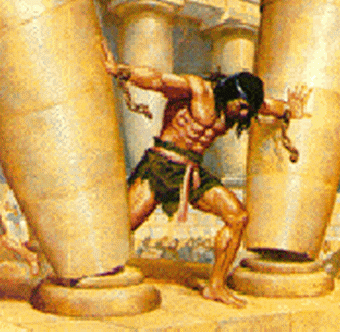
Samson the Judge of Israel
the books of those names. The people wanted a king, and the other historical books give accounts of the kingdom in Israel through Saul, David, Solomon,then the division of the land into two kingdoms. The story continues with the capture of the two kingdoms, the North by Assyria in 721 BC, the South by Babylon in 586 BC. Ezra and Nehemiah tell of the return after captivity to rebuild the temple and wall around Jerusalem.

King Solomon
The wisdom books supply us with the instructive story of Job, an exploration on the meaning of human suffering, the beauty and inspiration of a prayer and hymn book—the Psalms, and the down to earth practical wisdom of Proverbs. Then there is the earthly wisdom and analysis of Ecclesiastes and the rapturous love epic in Song of Solomon.
The prophets speak to the nation and interpret God’s dealings with His people. They warn against idolatry, declare judgment on the people when they depart from God’s ways, but they also show the love and compassion of God to forgive, call His people back, establish a new covenant, send a promised Messiah and ultimately fulfill the Divine purposes for the world.
The minor prophets are called minor not because they are unimportant but because they are briefer books. They are also known as “The Twelve.” These various writers continue the tradition of judgment and comfort. They contain some of the most piercing social criticism ever written.The Jews are continually warned of the punishments for infidelity to God’s ways, and the faithfulness of God to restore his people in spite of their sins.Within the prophetic books there are many accounts of the steep price these spokesmen paid for their bold and courageous pronouncements. As you might guess, their message was often rejected and the prophets themselves attacked.
Gathering the Collection

Ancient Parchments
The Old Testament collection was written over many centuries as we have noted. Scholars observe that there were oral traditions as well as written accounts. Stories were told over and over, detail by detail, when the covenant people gathered around their campfires. And the stories were preserved on parchment,or animal skins, so the account of God’s dealing with his people would never be forgotten. The parchments were rolled up into scrolls.Over the centuries more scrolls were written and added to the collection. Some were recognized as having special importance and came to be regarded as sacred text or holy scripture.
Of course, none of the original scroll writings has been preserved. Scrolls would wear out and were given an honored burial. But before they wore out, copies would be made and then copies of copies.
Inasmuch as the books were written over at least a thousand-year period, there was an ongoing process to gather the collection. The early books of the law were stored in the ark of the tabernacle (Deuteronomy 31:26). The nation reconsecrated its devotion to the sacred writings at different times (II Kings 23:1-3, Nehemiah 8:1ff).
By the time of Jesus it seems that there was general agreement on what constituted the recognized collection of sacred scrolls for the Jewish people. They are summed up in Jesus’ reference to the three main sections of the Hebrew scriptures when He noted that “Everything must be fulfilled that is written about me in the Law of Moses, the Prophets and the Psalms.” Luke 24:44

Jerusalem Temple Destruction by Titus
A major tragedy in the life of the Jewish nation occurred in 70 AD when the Jewish temple, the center of Jewish religious life,was destroyed by the Romans under Titus Livy. It is commonly thought that at a gathering of rabbis in the city of Jamnia in 90 AD there was a re-affirmation and confirmation of what fully and finally constituted the Hebrew scriptures. The Jewish historian Josephus,writing in the early 90’s AD in his Against Apion, observed:For we have not countless books among us, disagreeing and contradicting one another but only twenty-two books, which contain the records of all the past times; which are justly believed to be divine…and how firmly we have given credit to these books of our nation is evident by what we do; for during so many ages as have already passed, no one hath been so bold as either to add anything to them, to take anything from them, or to make any change in them, but it has become natural to all Jews, immediately and from their very birth, to esteem these books to contain divine doctrines, and to persist in them, and if occasion be, willingly to die for them.
An Amazingly Reliable Preservation
Are the copies of the Old Testament writings we have today anything like what was originally written down so long ago? Quite amazingly, the answer is yes. For the most part we can be confident that what we have today is nearly identical to the ancient copies. We back that up by drawing your attention to the scribes and the scrolls.
The Scribes
The copies of the scrolls of Hebrew scripture were made by a special group known as scribes. Israelite scribes learned their craft as a kind of holy profession in family-like guilds as is attested in the Bible that mentions “Clans of Scribes who inhabit Jabez” I Chronicles 2:55.
The Hebrew word for scribe is sofer. Its root meaning is “to count.” And scribes indeed were careful counters making sure every word and letter were accounted for. They worked under very strict conditions and regulations. They went about their work with a seriousness many would consider almost fanatical today. For example, the Jewish Masoretic scribes,who made hand written copies of the Bible worked under rules designed to insure utmost accuracy.
• No word or letter could be written from memory (the scribe had to say the word aloud).
• Before writing the sacred name of God, the scribe had to pause and wipe his pen.
• A scroll was discarded if spelling errors were found.
• Perhaps most important—after copying, every single word and every letter was counted to verify accuracy and to be sure they matched the original.
• Before beginning his work, a scribe would cleanse himself in a ritual bath—a vivid evidence of the seriousness and sacredness of the task of writing a scroll. He was going to write the names of God and must do so with proper devotion and ritual purity.
The Scrolls

Qumran cave where the Dead Sea Scrolls were found
Then there are the Dead Sea Scrolls. Maybe you have heard the fascinating story of how a Bedouin shepherd boy in 1947 was out with his flock along the cliffs on the northwest side of the Dead Sea.
He thoughtlessly threw a rock into one of the caves.
He heard something break. He investigated and found ancient scrolls stored in large pottery jars.
The lad had accidentally stumbled across the greatest manuscript discovery of modern times. Many of these scrolls date back to before the time of Jesus, and they include copies of sections of every Old Testament book except Esther. There is an almost complete copy of the book of Isaiah. Up until the discovery of the scrolls, the oldest available copies of the Hebrew scriptures dated from around 900 AD. These Dead Sea scrolls provided Hebrew text that was one thousand years earlier and would show if the text had been corrupted and changed over ten centuries. So it was a priceless opportunity to see if copies done so much later in any way resembled much earlier copies, that were themselves, of course, that much closer to the originals.
So, just how well had the scribes done their job over so many generations? Scholars analyzed and discovered there were some differences. That is not the surprising part.
What is surprising is that there were so few differences and they were primarily on small matters such as minor spelling variations. This is so amazing that it would almost seem impossible. The first ancient Qumran texts led to just thirteen minor yet clarifying alterations in the modern Revised Standard version of the Bible.

Section of scroll of Isaiah from the Dead Sea Scrolls
Explore posts in the same categories: Bible
 Why I Believe...
Leave a comment